FKBAR: Modular Architecture for Scalable Systems
Last Updated on March 26, 2026 by Admin
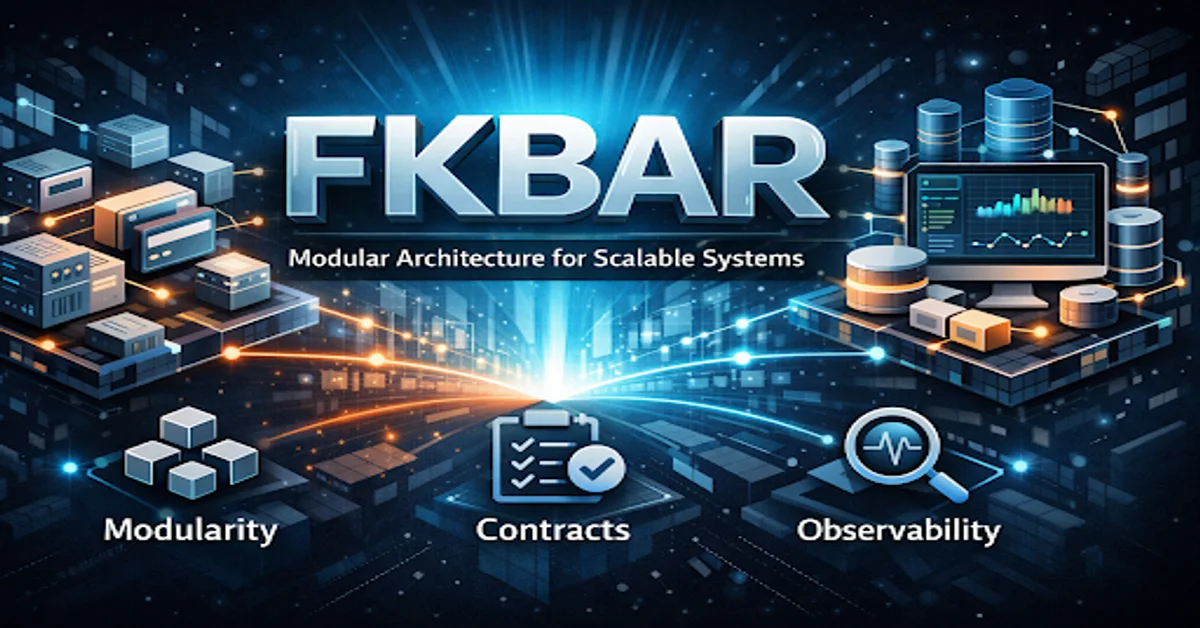
FKBAR is a cutting-edge conceptual framework designed to structure complex digital systems with precision, predictability, and modularity. It is a contract-driven architecture that enforces disciplined modularity and ensures that every component in a system interacts in a well-defined and governed manner. Unlike traditional monolithic systems, FKBAR separates concerns into distinct modules, each with explicit boundaries and validated contracts, making large-scale systems maintainable and adaptive.
While FKBAR is not an official international standard, it has gained recognition among software architects, engineers, and enterprise strategists for its practical approach to modular system architecture. By enforcing boundary architecture principles, FKBAR transforms complex infrastructures into resilient, adaptive ecosystems, providing a foundation for scalability, observability, and innovation.
In today’s fast-paced digital landscape, organizations face challenges with scalability, resilience, and operational efficiency. Traditional monolithic architecture often struggles to adapt to changes, leading to cascading failures, technical debt, and prolonged system downtime. FKBAR addresses these challenges by emphasizing transparent dependencies, replaceable software modules, and disciplined modularity.
Adopting FKBAR allows teams to innovate safely, integrate new technologies seamlessly, and respond to market demands quickly. Its principles align closely with domain-driven design techniques, composable enterprise platforms, and event-driven systems, positioning it as a strategic asset for modern software-driven organizations.
RELATED: Pentikioyr: Meaning, Origins, and Uses
Understanding the Core Architecture of FKBAR
Boundary-Driven Module Design
Boundary-driven module design is central to FKBAR. Each module operates within clearly defined limits, known as system boundaries, ensuring that interactions between modules are explicit and controlled. This approach is inspired by the entity–control–boundary pattern, where responsibilities are distributed logically, avoiding tight coupling and hidden dependencies.
By enforcing boundaries, FKBAR enables independent deployability, meaning modules can be updated or replaced without impacting the overall system. This design also facilitates horizontal extensibility, allowing systems to scale seamlessly as business requirements evolve.
Contract Validation and Enforcement
Contracts define how modules communicate. In FKBAR, interface contracts are formalized, validated, and strictly enforced. This includes data schemas, input-output validations, and interaction rules. Proper contract enforcement prevents cascading failures, reduces bugs, and ensures that modules can evolve independently.
Contract-driven governance also simplifies enterprise system integration. When new modules or external services are introduced, their interactions are predictable, eliminating surprises and minimizing operational risk.
Observability: Built-in System Monitoring
Observability is a key differentiator of FKBAR. Unlike traditional architectures where monitoring is often retrofitted, FKBAR integrates logging, tracing, and performance metrics from the start.
This allows teams to measure system behavior in real-time, monitor dependencies, and maintain reliability. Observability supports iterative architectural refactoring, making it easier to evolve complex systems without compromising stability.
Replaceable and Upgradeable Components
In FKBAR, every component is designed to be replaceable. Modules can be upgraded, replaced, or refactored independently. This ensures that technical debt is minimized and systems remain adaptive software ecosystems capable of supporting continuous innovation.
The ability to replace modules without affecting the broader system is particularly valuable in scalable enterprise architecture, enabling organizations to adopt new technologies without downtime or risk.
FKBAR vs Traditional Architectural Approaches
Monolithic Architecture vs FKBAR
Monolithic architecture consolidates logic, data, and business rules into a single, tightly coupled system. While simple to develop initially, monoliths often struggle with scalability, maintainability, and risk containment. A single failure can cascade throughout the system, increasing downtime and operational costs.
FKBAR contrasts this approach by modularizing components, enforcing contracts, and providing built-in observability. This makes systems more resilient, maintainable, and easier to scale. Teams can focus on independent component development without fearing disruptions to the entire architecture.
Microservices vs FKBAR
Microservices architecture also emphasizes modularity, but FKBAR differentiates itself through structured boundaries, explicit contracts, and governance frameworks. While microservices break applications into services, FKBAR provides disciplined modularity, ensuring each component follows boundary architecture principles and integrates predictably.
In practice, FKBAR complements microservices by adding systematic governance and operational oversight, reducing the risk of service sprawl or inconsistent behavior across modules.
Advantages of FKBAR in Complex Systems
- Predictable Evolution – Changes in one module don’t compromise system stability.
- Reduced Technical Debt – Modular, replaceable components minimize long-term maintenance burdens.
- Operational Efficiency – Integrated observability reduces monitoring gaps and accelerates problem resolution.
- Strategic Alignment – Modular governance supports business scalability and adaptability.
Business Implications of Adopting FKBAR
Improved Operational Efficiency
By enforcing modular governance and observability, FKBAR reduces downtime and improves operational workflows. Teams can implement upgrades confidently, monitor performance, and ensure transparent dependencies are properly managed.
This translates to faster release cycles, reduced bottlenecks, and enhanced reliability, giving businesses a measurable edge in competitive markets.
Reducing Technical Debt
FKBAR’s modular design and iterative refactoring reduce accumulated technical debt. Legacy components can be gradually updated without system-wide disruption, allowing organizations to maintain modern, scalable enterprise architecture while avoiding costly rewrites.
Accelerating Team Onboarding and Innovation
With clearly defined modules and interface contracts, new engineers can quickly understand system behavior, reducing onboarding time. Teams can focus on innovation rather than troubleshooting hidden dependencies, enabling faster delivery of new features and services.
Strategic Competitive Advantages
Organizations adopting FKBAR benefit from predictable scalability, operational resilience, and enhanced system clarity. These advantages translate directly to market responsiveness and strategic positioning, making FKBAR a vital tool for enterprises seeking sustained growth.
How to Implement FKBAR in Real-World Systems
Step 1: Boundary Identification
Begin by mapping logical separations between domains and services. Identify modules that can operate independently while maintaining controlled interactions. This step ensures architectural boundary enforcement and prevents hidden dependencies.
Step 2: Formalizing Contracts
Define interface contracts that govern module interactions. This includes input validation, output constraints, and data schemas. Contract formalization ensures consistent behavior and system integrity.
Step 3: Integrating Observability
Embed monitoring, logging, and tracing into each module. Observability allows teams to track performance, detect anomalies, and maintain reliability using operational metrics and KPIs.
Step 4: Managing Dependencies Transparently
Document all module dependencies explicitly. Transparent dependency management ensures that changes or upgrades in one module don’t introduce unforeseen issues, supporting scalability and resilience engineering.
Step 5: Iterative Refactoring of Legacy Systems
Transition legacy systems incrementally, updating or replacing modules step by step. Iterative refactoring minimizes risk while gradually aligning the system with modular design principles.
Governance and Operational Discipline in FKBAR
Architectural Review Boards and Oversight
Implement a review board to evaluate architectural changes. This ensures governance protocols are followed and system integrity is maintained.
Version-Controlled Interfaces
Maintain version control for modules and interfaces. This allows teams to track changes, roll back problematic updates, and maintain consistent contract enforcement.
Lifecycle and Dependency Management
Strictly manage module lifecycles and dependencies. Clear ownership and documentation prevent operational chaos and support technical governance frameworks.
KPIs for Measuring System Health
Define measurable goals for system performance, uptime, and reliability. Monitoring KPIs and operational metrics ensures that FKBAR implementations deliver predictable results.
Common Risks and Misconceptions about FKBAR
Over-Segmentation and Excessive Complexity
Dividing a system into too many modules can create unnecessary overhead. FKBAR requires a balance between modularity and operational simplicity.
Weak Contract Enforcement
Without strict contract validation, modules may interact unpredictably, undermining system reliability. API contract enforcement is critical.
Inadequate Observability
Failing to integrate monitoring from the start reduces visibility into system behavior. Observability should be built-in, not retrofitted.
Misalignment with Business Goals
FKBAR must align with strategic objectives. Excessive focus on technical perfection without business context can create friction and inefficiency.
Future Outlook: FKBAR in Next-Generation Systems
Alignment with Domain-Driven Design
FKBAR naturally complements domain-driven design (DDD) by defining clear boundaries and responsibilities across complex business domains.
Event-Driven Systems and Composable Architectures
FKBAR principles integrate seamlessly with event-driven architectures and composable enterprise platforms, supporting modern, scalable, and adaptive systems.
Scalable, Adaptive, and Resilient Enterprise Systems
By combining modular governance, replaceable components, and observability, FKBAR ensures long-term system resilience and scalability, making it a cornerstone for next-generation enterprise architecture.
Case Studies / Practical Examples of FKBAR
Hypothetical Example: FKBAR in E-commerce Systems
An e-commerce platform using FKBAR modularizes inventory, payment, and user modules, enabling seamless upgrades without affecting operations. Contract enforcement and observability prevent transactional failures and improve customer experience.
Hypothetical Example: FKBAR in Financial Platforms
A financial services system applies FKBAR to risk analysis, transaction processing, and reporting modules. Transparent dependencies and replaceable modules allow continuous innovation while maintaining regulatory compliance and system integrity.
RELATED: Sofoximmo: Smart Real Estate Platform Explained
Summary
FKBAR combines modular architecture, contract-driven design, and integrated observability to create resilient, maintainable, and adaptable systems. Businesses benefit from reduced technical debt, faster innovation, and improved operational efficiency.
By enforcing modular boundaries and structured governance, FKBAR ensures predictable system growth and long-term adaptability. Organizations can evolve their digital ecosystems safely while maintaining reliability.
FKBAR is not a trend—it is a strategic philosophy. Proper implementation converts technical discipline into operational excellence, positioning businesses for competitive advantage in the digital era.
Frequently Asked Questions
Is FKBAR an official technical standard?
No. FKBAR is a conceptual framework providing best practices for modular system architecture rather than a formal international standard.
Can FKBAR be applied to legacy systems?
Yes. Through iterative refactoring and boundary identification, legacy systems can adopt FKBAR principles gradually.
How is FKBAR different from microservices?
While microservices focus on service decomposition, FKBAR emphasizes structured boundaries, explicit contracts, and governed modularity.
Is FKBAR suitable for startups?
Yes, selectively. Early-stage companies benefit from modular governance but must balance complexity with operational speed.