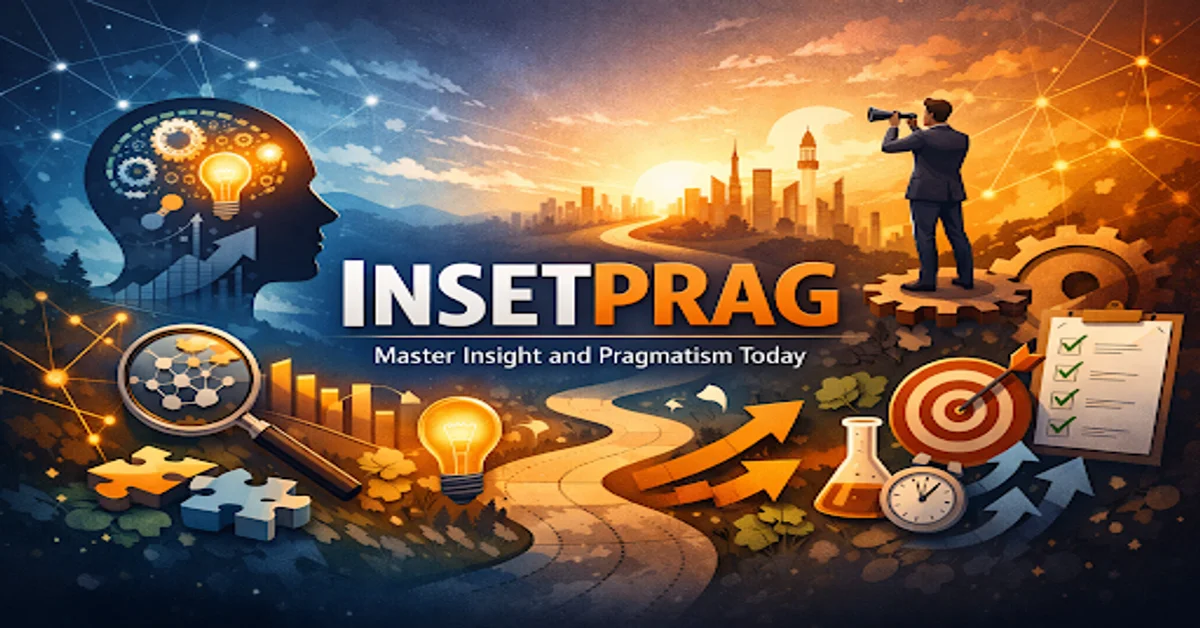
Insetprag: Master Insight and Pragmatism Today
Last Updated on March 26, 2026 by Admin
Insetprag is a crisp, actionable mindset built on one simple idea: combine deep insight with down-to-earth pragmatism. At its core, Insetprag asks you to scan beneath the surface of a situation, spot the meaningful patterns, and then choose practical, high-impact moves that you can implement right now. This blend—insightful decision-making plus practical problem-solving—offers a resilient mindset for modern life.
Insetprag merges two pillars: insight (seeing the system clearly) and pragmatism (choosing what actually works). Insight includes pattern recognition, situational analysis, and reflective thinking—abilities that help reveal leverage points. Pragmatism means selecting pragmatic solutions in real life: simple, testable, and scalable actions that minimize wasted effort.
The combination is powerful because insight ensures relevance while pragmatism ensures results. Insight helps you ask the right questions—what is the real problem, not just the obvious symptom. Pragmatism forces you to prioritize interventions that deliver measurable outcomes now.
RELATED: Pentikioyr: Meaning, Origins, and Uses
Understanding Insetprag: The First Pillar of Insetprag
What is insight, and why is it crucial
Insight is the capacity to see beyond noise—recognizing patterns, distinguishing cause from correlation, and detecting latent opportunities. It’s the “aha” that lets you reframe a problem into solvable parts. Insight is cultivated through situational analysis, reflective thinking, and data-driven decision making.
Insight matters because it points you to leverage points that magnify impact. Instead of applying brute force solutions, insight helps you design interventions that are efficient and elegant. This is the backbone of insight-driven decision-making and critical thinking strategies.
Recognizing patterns and hidden opportunities
Recognizing patterns requires cognitive flexibility and disciplined observation. Train yourself to map systems, note recurring themes, and test hypotheses. Small experiments and feedback loops sharpen your insight: observe, hypothesize, test, learn.
Leaders like Steve Jobs and Angela Merkel illustrate the power of insight paired with discipline—Jobs in product vision and Merkel in policy analysis. Their examples show how situational analysis and steady judgment produce meaningful, sustained results.
Embracing Pragmatism: The Second Pillar of Insetprag
Defining pragmatism and its practical value
Pragmatism is a philosophy of action: truth and value are measured by practical outcomes. Pragmatism philosophy encourages us to prioritize what works in the moment and to iterate based on results. It’s about practical execution skills and adopting solutions that survive real-world constraints.
This emphasis on practicality transforms lofty ideas into workable plans. Pragmatism grounds insight: an elegant idea without viable execution is a lost opportunity. Pragmatic solutions in real life focus on doable steps, resource awareness, and time-bound experiments.
How pragmatism complements insight
Pragmatism complements insight by converting revelations into scalable action. Where insight reveals the target, pragmatism equips you with the aim and the tools. Together they form a cycle—insight informs action; action generates data that refines insight.
Historical thinkers like John Dewey and early founders of the movement such as Charles Sanders Peirce and William James remind us that pragmatism has deep intellectual roots. Their work underpins modern adaptive problem-solving techniques and the critical analysis framework we use today.
The Benefits of an Insetprag Mindset
Personal growth: enhancing resilience and adaptability
Adopting Insetprag builds adaptive resilience. When you lean on insight to understand the real problem and on pragmatism to test solutions quickly, you recover from setbacks faster. You stop treating failure as defeat and start seeing it as information—fuel for the next, smarter attempt.
This mindset also supports emotional steadiness: a reflective thinking habit reduces reactivity and increases confidence. Personal growth with a practical mindset becomes sustainable because it’s anchored in real change, not just aspiration.
Professional growth: strategic decision-making and problem-solving
Professionally, Insetprag fosters strategic thinking skills and better team outcomes. Teams that practice data-driven decision making and effective action planning deliver higher quality results. Leaders who model insight + pragmatism encourage adaptive leadership and innovation strategy across their organizations.
Relationships and teamwork benefit too: clarity of purpose and measurable steps reduce conflict, improve collaboration, and keep groups moving toward common goals.
How to Cultivate an Insetprag Mindset
Self-awareness and reflection
Start with self-awareness: map how you normally solve problems. Do you lean to analysis paralysis or to snap decisions? Reflective thinking—journaling or post-action reviews—reveals habits that help or hinder. Make a practice of pausing to frame problems before proposing solutions.
Embracing curiosity and diverse perspectives
Curiosity expands your insight: read widely, ask wide questions, and invite dissenting views. Diverse perspectives expose hidden assumptions and increase cognitive flexibility. Surrounding yourself with cross-disciplinary thinkers multiplies the ideas you can test.
Critical thinking and experimentation
Adopt a problem-solving cycle: situational analysis → hypothesis → small experiment → measure → iterate. Use critical thinking strategies to evaluate evidence and avoid cognitive traps. Small, frequent experiments produce fast learning with limited risk.
Real-Life Examples of Successful Insetprag Thinkers
Steve Jobs: Innovation grounded in practicality
Jobs combined intense insight about user needs with ruthless pragmatism in design and execution. His insistence on prototypes, user testing, and design constraints turned brilliant ideas into products people loved.
Angela Merkel: Pragmatic leadership during crises
Merkel’s leadership shows how steady situational analysis and moderate, practical steps can guide nations through crises. Her methodical approach reflected data-driven decision making, coalition building, and risk-aware policy choices.
Elon Musk: Insight + feasibility in tech and space
Musk demonstrates bold vision while rigorously engineering for feasibility. Applying iterative testing and aggressive cost optimization, his teams convert audacious ideas into low-friction innovations.
Malala Yousafzai: Actionable advocacy with deep insight
Malala’s advocacy blends deep personal insight into barriers for girls’ education with pragmatic campaigns and partnerships that deliver measurable impact—showing how empathy and practicality amplify social change.
These examples illustrate strategic execution and real-world actionable solutions: vision meets testable planning.
Applying Insetprag in Daily Life
Making better personal decisions
Use a two-step habit: analyze (2–5 minutes) + act (first small step). For example, when facing a major life decision, list core values (insight) and identify one small experiment or conversation that tests the assumption (pragmatism). This approach reduces regret and builds momentum.
Problem-solving at work and in projects
At work, use short experiments and measurable metrics. Replace endless planning with small pilots. Frame success criteria early and iterate quickly. Data-driven decision-making paired with contextual awareness helps teams adapt without losing focus.
Using insight + pragmatism for long-term goals
Long-term goals benefit from periodic review. Schedule quarterly reflection: evaluate what you’ve learned (insight), then pick pragmatic course corrections (effective action planning). This steady cadence converts aspiration into progress.
Overcoming Challenges and Obstacles with Insetprag
Analyzing problems deeply before acting
Avoid rushing to solutions. Spend time mapping the system and testing assumptions. This critical analysis framework prevents wasted effort on symptoms rather than causes.
Practical solutions over theoretical ideas
Favor workable pilots over grand theory. When facing resource limits, choose elegant, simple interventions that can be scaled. Prioritize outcomes that are measurable and repeatable.
Learning from failures and adapting strategies
Failure is information. Build feedback loops that translate outcomes into updated insight. Use adaptive resilience techniques: short learning cycles, transparent metrics, and team retrospectives to sharpen both insight and pragmatism.
Common Mistakes to Avoid While Practicing Insetprag
Overthinking without execution
Perfectionism and endless options kill momentum. Set a decision threshold: if a recommendation meets minimum viability metrics, test it rather than debating indefinitely.
Ignoring practical constraints
Great ideas require resource mapping. Always ask: what will it cost? Who will do the work? What is the first measurable outcome? Ignoring constraints turns insight into wishful thinking.
Relying solely on intuition or theory
Neither pure intuition nor pure theory is sufficient. Combine personal judgment with data and small experiments. That balanced approach reduces bias while preserving creative spark.
Practical Tools & Exercises to Build Your Insetprag Muscle
The 5-Minute Insight Map
Spend five minutes writing the problem, stakeholders, assumptions, and one hidden pattern you suspect. This quick mapping sharpens situational analysis.
The Mini-Experiment Protocol
Define a 7-day test with one measurable metric and a clear stop condition. Run the test, collect results, and iterate.
Reflective Post-Action Review
After any initiative, ask: What did we learn? What worked? What would we change? Keep the review under 20 minutes and record two insights and one pragmatic next step.
These exercises reinforce cognitive flexibility, practical execution skills, and an innovative mindset.
Summary
Insetprag is a potent, optimistic approach to life: it teaches you to look deeper, act smarter, and learn faster. By blending insight with pragmatism, you create a decision-making framework that’s both visionary and grounded. Whether you’re solving team challenges, pursuing personal growth, or launching a bold project, this mindset equips you to convert ideas into measurable progress.
Start small, test quickly, and iterate openly. With steady practice, Insetprag becomes more than a technique—it becomes a habit that powers resilient, impactful living.
RELATED: Who is Kirk Gerndt? All You Need To Know
Frequently Asked Questions
What exactly does “Insetprag” mean?
Insetprag combines insight (deep understanding and situational analysis) with pragmatism (practical, outcome-focused action). It’s a mindset for making decisions that are both smart and doable.
How is Insetprag different from general critical thinking?
Critical thinking emphasizes analysis; Insetprag insists you follow analysis with small, measurable actions. It pairs evaluation with pragmatic execution.
Can anyone develop an Insetprag mindset?
Yes. The key practices—reflective thinking, small experiments, and diverse input—are teachable and repeatable. Start with short experiments and regular reflection.
Are there famous thinkers who influenced Insetprag?
Yes—roots of pragmatism trace to philosophers like Charles Sanders Peirce, William James, and John Dewey. Modern examples include innovators and leaders who blend insight with action.
How do teams use Insetprag in the workplace?
Teams use short pilots, defined success metrics, and regular retrospectives. Emphasize data-driven decision making, adaptive leadership, and transparent accountability.