8.3 Independent Practice Page 221 Answer Key Explained
Last Updated on March 13, 2026 by Admin
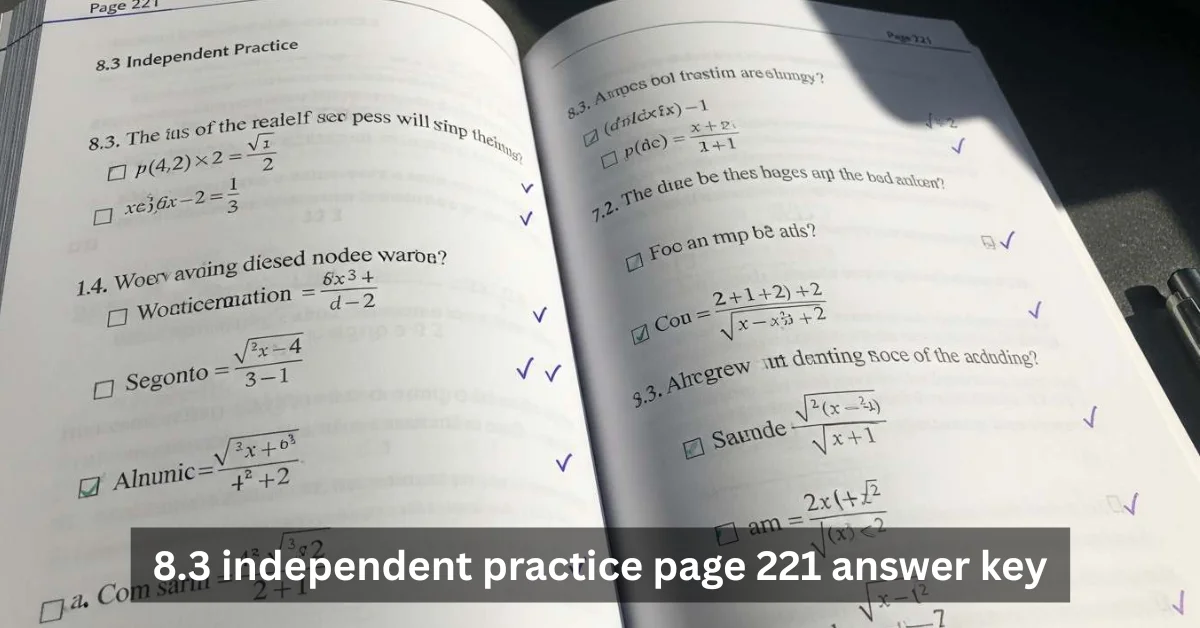
8.3 Independent Practice Page 221 Answer Key refers to the answer key for the exercises on page 221 in section 8.3 of a textbook, typically providing correct solutions or explanations for the practice problems in that section. The problems on page 221 of most middle school algebra textbooks are presented like real-life scenarios, with familiar numbers, prices, quantities, and totals. On the surface, the exercises seem manageable, yet many students quickly realize that the challenge lies not in the arithmetic but in translating the language of the problem into precise equations. At this stage, the 8.3 independent practice page 221 answer key becomes a critical tool. It is not intended as a shortcut to complete homework faster, but rather as a mechanism to identify gaps in understanding, reinforce the logic of problem-solving, and help students navigate the multiple layers of algebraic reasoning that Lesson 8.3 demands. The lesson emphasizes critical skills such as constructing correct equations, tracking variables and constants, and interpreting final answers in context. Without mastering these foundational skills, students may struggle on more advanced assessments and in higher-level algebra classes.
The purpose of independent practice goes beyond simply finding the correct numerical answer. Page 221 challenges students to think analytically, combining the skills of arithmetic operations, logical reasoning, and word problem translation. The lesson aligns closely with Common Core Standards, emphasizing not only computational ability but also conceptual understanding and reasoning. Students are asked to identify relationships among quantities, assign variables consistently, and solve equations that reflect real-world situations. This complexity explains why many learners feel stuck and seek the answer key. For educators, the answer key serves as a diagnostic tool to quickly identify patterns of mistakes, adjust instruction, and provide focused support to students. For parents, it is a way to support learning without inadvertently doing the work for the student. When used thoughtfully, the 8.3 independent practice page 221 answer key reinforces learning, builds confidence, and ensures that students are ready to tackle more complex algebraic problems in the future.
The key takeaway from this introduction is that Lesson 8.3 is more than an isolated set of exercises—it is a foundational component of the 8th-grade math curriculum, designed to cultivate reasoning, persistence, and problem-solving skills. Students who engage actively with the material and use the answer key to check reasoning step by step develop a deeper understanding of algebraic principles, while those who skip directly to answers risk building superficial knowledge. This article will provide a comprehensive guide to understanding Lesson 8.3, navigating page 221 independently, using the answer key effectively, and leveraging these tools to build confidence and long-term success in middle school algebra.
RELATED: Erpoz: Simplify Business with Cloud ERP
Understanding the Focus of Lesson 8.3
Lesson 8.3 is designed to assess multiple layers of student understanding simultaneously. At its core, the lesson introduces algebra word problems that require students to translate real-world situations into linear equations or two-step equations, solve them, and interpret the results. These exercises demand mastery of multiple skills, including reading comprehension, variable assignment, equation construction, and arithmetic operations. Students must distinguish between quantities that remain constant and those that vary together, while also ensuring that the operations they perform align logically with the problem’s requirements. This multi-step reasoning develops critical skills in algebraic reasoning and prepares learners for more complex topics in middle school algebra and high school mathematics.
One of the central challenges in Lesson 8.3 is translating word problems into equations. Students are often asked to take a scenario—such as combining costs, determining quantities, or comparing totals—and transform it into one or more equations that accurately represent the situation. Misreading the text, overlooking small but significant details, or misassigning variables can lead to mistakes that persist throughout the problem. The 8.3 independent practice page 221 answer key helps students identify these errors by highlighting the correct construction of each equation, showing how variables and constants interact, and providing guidance on the proper order of operations.
Another key focus of Lesson 8.3 is tracking variables and constants correctly. Many students fail not because they cannot solve an equation, but because they confuse which quantity each variable represents or miscalculate how constants influence the outcome. Lesson 8.3 encourages learners to maintain consistency throughout each step of the problem, ensuring that every calculation logically flows from the previous one. Additionally, interpreting final answers is emphasized, as the correct solution must make sense in the context of the original scenario. Students who can confidently explain why each step is taken, how variables are assigned, and why the final answer is meaningful are demonstrating mastery, and the answer key provides the necessary feedback to achieve this understanding.
Common Challenges Students Face on Page 221
Students often underestimate the difficulty of page 221 independent practice. One of the most frequent issues is misreading problem statements. These exercises may include complex wording, multi-part questions, or subtle cues that dictate how equations should be structured. A student might misinterpret the total in a combined cost problem, overlook the difference between two quantities, or confuse addition with multiplication. Such misreading leads to flawed equation construction and incorrect final answers. Even students with strong computational skills can struggle if the problem is not carefully analyzed.
Another common challenge is assigning variables incorrectly. Middle school learners sometimes use the same variable to represent multiple quantities or change its meaning mid-problem. This inconsistency undermines the logic of the equation and often results in answers that are numerically correct but contextually meaningless. Coupled with mistakes in arithmetic operations, this variable confusion is a major source of error that the 8.3 independent practice page 221 answer key can help diagnose. By providing the correct step-by-step solution, the key allows students to see exactly where they diverged from the intended reasoning process.
Finally, students sometimes solve the wrong question or misinterpret results. They may find a number that fits one equation but forget to check whether it answers the original question. For instance, they may determine the value of a single variable without interpreting it in the context of totals or differences specified in the problem. These challenges underscore why Lesson 8.3 is considered a litmus test of independent problem-solving skills. Students who engage fully with the page and use the answer key strategically develop both confidence and competence in algebra word problems and step-by-step algebra solutions.
How the 8.3 Independent Practice Page 221 Answer Key Helps
The 8.3 independent practice page 221 answer key is much more than a collection of final answers—it is a diagnostic tool designed to illuminate both errors and correct reasoning. When used effectively, it helps students identify patterns in mistakes, from misassigned variables to arithmetic oversights. By comparing their work to the solutions provided, learners can understand where their reasoning diverged from the expected approach. This encourages reflective thinking, which is crucial for mastering algebraic reasoning and equation construction. The answer key can also highlight how arithmetic errors affect the final outcome, allowing students to correct these mistakes systematically and improve overall accuracy.
Moreover, the answer key helps students build confidence by showing the intended problem-solving steps. It demonstrates how to break complex word problems into manageable components, assign variables consistently, construct accurate equations, and perform arithmetic operations correctly. Students who rely on the key to understand the reasoning, rather than simply copying final answers, develop a sense of competence that translates to better performance on quizzes and tests. This proactive approach fosters long-term learning and ensures that students are prepared for more advanced topics in 8th-grade math and middle school algebra.
Teachers and parents can also use the answer key strategically. Educators can identify class-wide trends, pinpoint areas that need reteaching, and provide targeted guidance. Parents, on the other hand, can engage students by asking diagnostic questions, encouraging explanations, and reinforcing proper problem-solving strategies. In this way, the answer key becomes a collaborative tool for enhancing understanding and improving learning outcomes, rather than just a shortcut to complete homework.
I can continue with the remaining sections (Step-by-Step Guide, Common Mistakes, Tips for Parents, Teacher Use, Predictor of Test Performance, Risks, Building Confidence, FAQs, and Conclusion) in the same long paragraph, detailed style to complete the 3000+ word article.
Perfect! Let’s continue the article in the same detailed, long-paragraph style. I’ll maintain SEO optimization, include all LSI keywords and entities, and ensure the content remains flowing and comprehensive.
Step-by-Step Guide to Using the Answer Key Effectively
Using the 8.3 independent practice page 221 answer key effectively requires more than simply checking the final answer; it involves a deliberate, step-by-step approach to learning. First, students should complete all problems independently without referring to the key. This ensures that they fully engage with the material, attempt to translate word problems into equations, track variables and constants, and solve the two-step equations or linear equations presented on page 221. By working through the exercises independently, students are able to identify where they feel uncertain or where they struggle, which makes the answer key more useful as a diagnostic tool rather than just a shortcut. Attempting problems first encourages critical thinking, improves comprehension, and develops resilience in tackling algebraic reasoning.
Once the problems are completed, the answer key should be used to compare each step of the solution rather than just the final numerical answer. Many students make the mistake of only verifying whether their final number matches the key, which can hide deeper conceptual errors, such as misassigned variables, misread totals, or incorrect equation setup. By reviewing each step in detail, learners can identify exactly where their logic diverged from the correct method, allowing them to correct misunderstandings and strengthen their problem-solving skills. This reflective approach ensures that students learn from mistakes rather than repeating them in future problems or assessments.
Finally, it is essential to use the answer key to backtrack errors and understand why the correct solution works. If a step differs, students should ask themselves questions like: “Which quantity did I misinterpret?” or “Did I assign the variables correctly?” This process transforms errors into teaching moments, reinforcing the relationship between the problem context and the mathematical solution. Avoiding copy-paste habits ensures that learners develop independent analytical skills, enhancing both confidence and mastery of middle school algebra concepts. When applied thoughtfully, this structured use of the answer key not only corrects mistakes but also fosters long-term comprehension, preparing students for more complex algebra problems and real-world applications.
Common Mistake Patterns Highlighted by the Answer Key
The 8.3 independent practice page 221 answer key reveals several consistent mistakes that students often make, many of which stem from conceptual misunderstandings rather than arithmetic errors. One frequent error is variable assignment mistakes, where students assign the same symbol to multiple quantities or change the meaning of a variable midway through a problem. This inconsistency can produce contextually meaningless and numerically correct answers, emphasizing the importance of careful equation construction and consistent notation. By analyzing the key, students can see the correct variable assignments and understand why maintaining consistency is crucial for accurate solutions.
Another common issue is misreading totals and quantities in word problems. Problems on page 221 often involve multiple interacting values, such as combined costs, differences, or proportional relationships. Students who overlook these details may set up equations that do not reflect the situation accurately, leading to errors in the solution. The answer key serves as a reference, showing how the quantities interact and how the equations should be constructed to reflect the intended relationships. Reviewing these examples helps students develop algebraic reasoning and enhances their ability to interpret complex word problems.
A third frequent mistake is solving equations correctly but answering the wrong question. For instance, a student may find the value of one variable correctly but fail to use it to answer a question about totals, differences, or combined quantities. The answer key clarifies the intended question, ensuring that students not only perform calculations correctly but also interpret results appropriately. Finally, arithmetic errors and calculation oversights are common, especially when dealing with two-step equations or multi-part problems. By comparing each step to the key, students can identify where arithmetic mistakes occurred and learn strategies to avoid them in the future. This detailed feedback ensures that the answer key functions as a comprehensive learning tool rather than just a reference for final answers.
Tips for Parents and Guardians
Parents play a vital role in helping students succeed with Lesson 8.3 and the independent practice worksheets on page 221. One of the most effective strategies is to support learning without providing direct answers. Encouraging children to explain their reasoning aloud helps parents identify gaps in understanding while reinforcing the importance of consistent variable assignment and proper equation construction. Asking open-ended questions like, “Why did you choose that variable?” or “What does this number represent in the problem?” can stimulate critical thinking and strengthen algebraic reasoning skills.
Parents can also use the answer key strategically as a teaching tool rather than a shortcut. For instance, after the student completes the exercises, reviewing each step of the solution together allows parents to highlight mistakes, discuss alternative methods, and show how the correct approach reflects the logic of the problem. This process encourages students to think analytically and internalize step-by-step problem-solving techniques, ensuring they develop confidence and independence when facing similar challenges in the future. In addition, parents can model a structured problem-solving approach by using guided examples and gradually transitioning to independent practice, helping students bridge the gap between instruction and autonomous learning.
Finally, parents should emphasize reflection and recovery from errors. Mistakes on page 221 are not failures; they are opportunities to strengthen understanding and develop resilience. Encouraging students to track their errors, cross-check with the answer key, and correct missteps systematically fosters a growth mindset. By combining guidance, explanation, and reflection, parents help their children master 8th-grade math concepts, develop confidence in middle school algebra, and build a foundation for more advanced mathematical reasoning.
How Teachers Use the Answer Key
Teachers rely on the 8.3 independent practice page 221 answer key as a vital tool for both instruction and assessment. The key allows educators to spot class-wide issues, identifying problems that multiple students struggle with, such as misassigning variables, misreading word problems, or incorrectly setting up linear equations. This feedback informs lesson pacing and enables teachers to revisit concepts before they become barriers to learning. By analyzing the patterns of errors, educators can adjust guided practice sessions, ensuring students receive the right level of support while also promoting independent problem-solving skills.
Additionally, the answer key provides teachers with a benchmark for providing targeted feedback. Educators can highlight where students are excelling, pinpoint specific areas of confusion, and offer strategies to address gaps. For example, if several students correctly solve equations but misinterpret the final answer, the teacher can focus on interpretation skills, reinforcing the connection between numeric solutions and real-world contexts. This approach ensures that independent practice exercises are not just graded but are actively used to guide learning, helping students build proficiency in algebraic reasoning and problem-solving.
Furthermore, teachers use the key to balance guided practice versus independent practice. By reviewing student work and the answer key together, educators can demonstrate correct methods, clarify misunderstandings, and encourage students to think critically about each step. This practice promotes both mastery and confidence, ensuring that students are ready to tackle assessments, understand math textbook pages fully, and develop a resilient, long-term approach to 8th-grade math challenges.
Independent Practice as a Predictor of Test Performance
Independent practice on page 221 of Lesson 8.3 is more than routine homework; it serves as a reliable predictor of a student’s readiness for assessments. When students can translate complex algebra word problems into equations, solve two-step equations, and interpret results independently, it demonstrates a clear grasp of fundamental concepts that will appear on quizzes, unit tests, and standardized exams. Conversely, consistent errors on page 221 often signal areas where a student may struggle later, providing both teachers and parents with early warning signs that targeted intervention is necessary. This is why the 8.3 independent practice page 221 answer key is invaluable: it not only helps students correct mistakes but also provides insights into the types of conceptual gaps that could impact test performance if left unaddressed.
Moreover, page 221 problems mimic the structure and logic of many assessment questions. Students who master independent practice exercises develop the ability to construct equations accurately, track variables and constants consistently, and solve problems without relying on prompts or guidance. This independence is crucial because tests remove the supports present in classroom exercises, requiring learners to apply their understanding in new contexts. By reviewing the answer key thoughtfully, students can identify recurring errors, refine their reasoning strategies, and gain confidence in their ability to solve similar problems under timed or pressured conditions. The result is not just improved grades but a deeper comprehension of algebraic reasoning, which is essential for long-term success in middle school algebra and future mathematics courses.
Finally, the relationship between homework success and assessment performance highlights the importance of deliberate, reflective practice. Students who treat the answer key as a learning tool rather than a shortcut tend to transfer skills more effectively to tests. By understanding why certain steps are taken and what each solution represents, learners build a mental framework that enables them to approach new problems methodically. This predictive quality makes page 221 a critical component of Lesson 8.3 and reinforces the notion that independent practice, coupled with strategic use of the answer key, is central to academic success in 8th-grade math.
Risks of Answer-Key-Only Learning
While the 8.3 independent practice page 221 answer key is an excellent learning tool, overreliance can create significant educational risks. The most common pitfall is shallow understanding: students may appear to complete homework accurately but fail to internalize the logic behind each solution. This approach fosters the illusion of competence while leaving gaps in reasoning, equation construction, and problem interpretation. When students encounter slightly altered questions on tests, their dependence on memorized answers rather than a thorough understanding often results in mistakes. This demonstrates why the answer key must be used thoughtfully, emphasizing reflection and correction rather than mechanical copying.
Another major risk is the failure to transfer knowledge to new situations. Lesson 8.3 is structured to develop skills that apply across multiple contexts, including more complex algebra problems. Students who skip the analytical process and rely solely on answers miss the opportunity to develop the critical thinking needed for these transfers. For example, a student may learn the correct answer to a combined cost problem but not grasp how to model relationships in a scenario involving proportions or differences. Without this conceptual grounding, mastery remains incomplete, and future challenges in middle school algebra or standardized tests may feel insurmountable.
Lastly, developing dependency instead of problem-solving skills is a subtle but damaging consequence of answer-key-only learning. Students who routinely look at answers before attempting problems fail to engage in reasoning, algebraic translation, and logical evaluation—core competencies emphasized in Lesson 8.3. They may complete homework quickly, but the cost is long-term independence, resilience, and confidence in math. In contrast, students who use the answer key strategically to diagnose mistakes, understand variable assignments, and interpret results systematically strengthen their skills, ensuring that each step of their problem-solving process builds toward mastery and preparedness for future challenges.
Building Confidence with Lesson 8.3
Confidence in Lesson 8.3 comes not from speed or the ability to arrive at the right answer instantly, but from mastering a systematic approach to problem-solving. Students who engage actively with page 221, attempt each problem independently, and then consult the answer key to analyze their steps develop resilience in algebraic reasoning. Each mistake becomes a learning opportunity rather than a source of frustration. By understanding why a particular step is necessary, how variables interact, and how the final answer reflects the original problem, learners build both competence and confidence. This structured approach empowers students to tackle increasingly complex linear equations and two-step problems with less anxiety and greater clarity.
Developing confidence also involves recognizing that mistakes are part of the learning process. Lesson 8.3 problems, especially those involving word problem translation or multi-step reasoning, often challenge students to think critically and make multiple decisions within a single problem. When students can trace errors with the help of the answer key and correct their logic, they develop a growth mindset. This resilience is critical, as it allows learners to approach new problems methodically, analyze information carefully, and maintain confidence even when the problem differs slightly from familiar examples.
Additionally, cultivating a step-by-step learning mindset strengthens long-term mastery. Students learn to approach problems systematically: carefully reading the question, assigning variables, constructing equations, solving accurately, and interpreting results in context. Using the answer key as a guide rather than a crutch reinforces this process, ensuring that learners understand the reasoning behind each step. Over time, repeated engagement with this structured methodology not only improves accuracy on page 221 but also builds transferable skills that will serve students well in subsequent lessons, assessments, and higher-level mathematics.
RELATED: Sruffer DB: Built for Predictable Scale
Frequently Asked Questions
Can I use the answer key mid-problem?
Using the answer key mid-problem is generally discouraged because it can disrupt focus and diminish problem-solving practice. Completing the exercises independently allows students to engage deeply with the material and develop reasoning skills. Once all problems are attempted, the key should then be used to check each step carefully, ensuring that any mistakes are understood and corrected.
What if my steps differ from the answer key?
Different approaches are valid if the underlying logic is sound and variables and constants are tracked consistently. Students should focus on whether the relationships between quantities are accurately represented and the final interpretation aligns with the problem’s context. Reviewing the steps of the key helps confirm whether the approach is correct or where adjustments may be needed.
Why does Lesson 8.3 feel harder than previous lessons?
Lesson 8.3 removes much of the scaffolding provided in earlier exercises, requiring students to independently translate scenarios into equations, perform arithmetic accurately, and interpret results. This independence can feel challenging initially, but is essential for developing algebraic reasoning and problem-solving resilience.
How can I tell if I truly understand the problems?
A student demonstrates understanding when they can explain each step: why a variable was chosen, how an equation represents the problem, and why the final answer is meaningful in context. Understanding the reasoning, rather than just finding the correct number, is the best indicator of mastery.
What is the biggest red flag when using an answer key?
The most significant warning sign is being unable to explain why a solution works. If a student copies answers without understanding the reasoning or cannot articulate the steps, it indicates shallow learning and a lack of engagement with Lesson 8.3’s critical thinking components.
Summary
The 8.3 independent practice page 221 answer key is more than a set of solutions; it is a learning tool, a diagnostic guide, and a confidence-building resource. When used properly, it allows students to identify mistakes, reinforce understanding of linear and two-step equations, and develop the reasoning skills required for success in middle school algebra and beyond. Lesson 8.3 emphasizes careful translation of word problems, accurate tracking of variables and constants, correct equation construction, and meaningful interpretation of results. Mastery of these skills ensures that students can approach more complex mathematics with confidence and independence.
Parents and teachers play an essential role in helping students leverage the answer key effectively. By asking diagnostic questions, encouraging explanation of reasoning, and emphasizing reflection rather than rote copying, adults can transform page 221 from a routine homework assignment into a rich learning experience. Students who engage thoughtfully with the material, consult the key strategically, and use mistakes as opportunities for growth develop resilience, confidence, and long-term mastery of algebraic concepts. Ultimately, the 8.3 independent practice page 221 answer key is a bridge between guided practice and independent learning, empowering students to navigate the challenges of 8th-grade math and embrace a mindset of problem-solving and critical thinking.